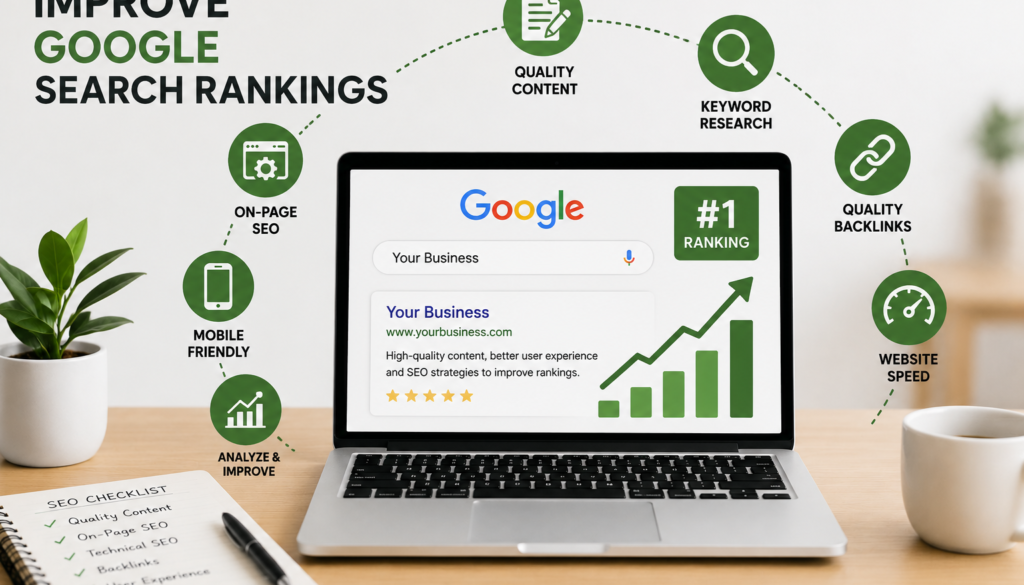
If you want to learn how to improve Google search rankings, you need more than simply adding keywords to your website. Google evaluates many factors, including content quality, website experience, technical SEO, backlinks, and how well your pages satisfy what people are searching for.
Whether you have a business website, blog, or portfolio, a strong SEO strategy can help your pages appear in front of the right audience
.
1. Create Helpful and Relevant Content
The foundation of SEO is useful content. Before writing an article, understand what your audience is actually searching for.
Instead of creating content only to use keywords, answer real questions and provide practical information.
For example, if you offer digital marketing services, you could create articles about:
- How SEO helps small businesses
- How social media marketing works
- How to choose a digital marketing strategist
- Local SEO tips for businesses
- Common SEO mistakes
Your content should be clear, original, useful, and easy to understand.
2. Use Keywords Naturally
Keywords help search engines understand what your page is about.
Choose one primary keyword for each important page and use related keywords naturally throughout the content.
For example, for an article targeting How to Improve Google Search Rankings, related terms could include:
- improve Google rankings
- Google search rankings
- SEO strategies
- on-page SEO
- technical SEO
- improve website visibility
Avoid keyword stuffing. Repeating the same keyword unnecessarily can make your content difficult to read and may hurt the quality of the page.
3. Optimize Your Page Titles and Headings
Your title tells both users and search engines what your page is about.
A good SEO title should be relevant and encourage people to click.
For example:
How to Improve Google Search Rankings: A Practical SEO Guide
Use headings such as H2 and H3 to organize your content. A well-structured article makes it easier for visitors to scan and understand.
4. Improve Your On-Page SEO
On-page SEO includes the elements you control directly on your website.
Pay attention to:
- SEO title
- Meta description
- Headings
- URL
- Keyword placement
- Internal links
- Image ALT text
- Content structure
Your URL should also be short and descriptive.
For example:
example.com/how-to-improve-google-search-rankings/
is better than a complicated URL containing unnecessary numbers or parameters.
5. Build Strong Internal Links
Internal links connect one page of your website to another.
For example, if you write an article about SEO, you can link naturally to your SEO services page.
Internal linking helps visitors discover more useful content and helps search engines understand the relationship between pages on your website.
For a portfolio website, connect your blog posts to relevant service pages, portfolio projects, and contact pages.
6. Improve Website Speed and Mobile Experience
A website that is slow or difficult to use can create a poor experience for visitors.
Make sure your website works well on smartphones, tablets, and desktops.
You can improve performance by:
- Compressing large images
- Using modern image formats
- Removing unnecessary plugins
- Using reliable hosting
- Reducing unnecessary scripts
- Keeping your WordPress website updated
A fast website is better for users and supports a stronger overall SEO strategy.
7. Earn Quality Backlinks
Backlinks are links from other websites to your website.
Relevant and trustworthy backlinks can help build your site’s authority.
You can earn backlinks by:
- Publishing original research
- Creating useful guides
- Writing guest articles
- Getting listed in relevant directories
- Building relationships with relevant websites
- Creating content that others naturally want to reference
Do not focus on buying large numbers of low-quality backlinks. A smaller number of relevant, trustworthy links is a better long-term approach.
8. Use Google Search Console
Google Search Console is an important tool for understanding how your website performs in Google Search.
You can use it to monitor:
- Search queries
- Impressions
- Clicks
- Average position
- Click-through rate
- Indexing problems
For example, you may discover that one of your pages receives many impressions but few clicks. Improving its title and meta description could potentially increase its click-through rate.
9. Focus on Local SEO
If you provide services in a specific location, local SEO can help you reach nearby customers.
For example, a digital marketing professional targeting Kannur could create useful content around topics such as:
Digital Marketing Strategist in Kannur
and
SEO Services in Kannur
Make sure your business information is accurate and consistent across relevant online profiles and directories.
10. Keep Improving Your Website
SEO is not a one-time task.
Google search results change, competitors publish new content, and user behaviour changes over time.
Regularly review your website and identify pages that need improvement.
Check your:
- Rankings
- Organic traffic
- Search queries
- Content quality
- Broken links
- Page speed
- Internal links
- Backlinks
- Indexing status
Conclusion
Learning how to improve Google search rankings requires a combination of useful content, keyword research, on-page SEO, technical improvements, internal linking, backlinks, and a good user experience.
Don’t try to manipulate Google with keyword stuffing or low-quality content. Build a website that genuinely helps people find the information, products, or services they need.
If you consistently improve your website and measure your results, you can build stronger search visibility over time and attract more relevant visitors through organic search.
If you’re looking for expert guidance on SEO, content marketing, WordPress, or digital marketing strategies, connect with a Digital Marketing Strategist in Kannur to build a results-driven online presence and grow your business more effectively.

Midhuna M
Midhuna M is a Digital Marketing Strategist in Kannur with a passion for helping businesses build a strong online presence through effective digital marketing strategies. She specializes in Search Engine Optimization (SEO), content marketing, WordPress website development, social media marketing, and performance-driven digital campaigns.